


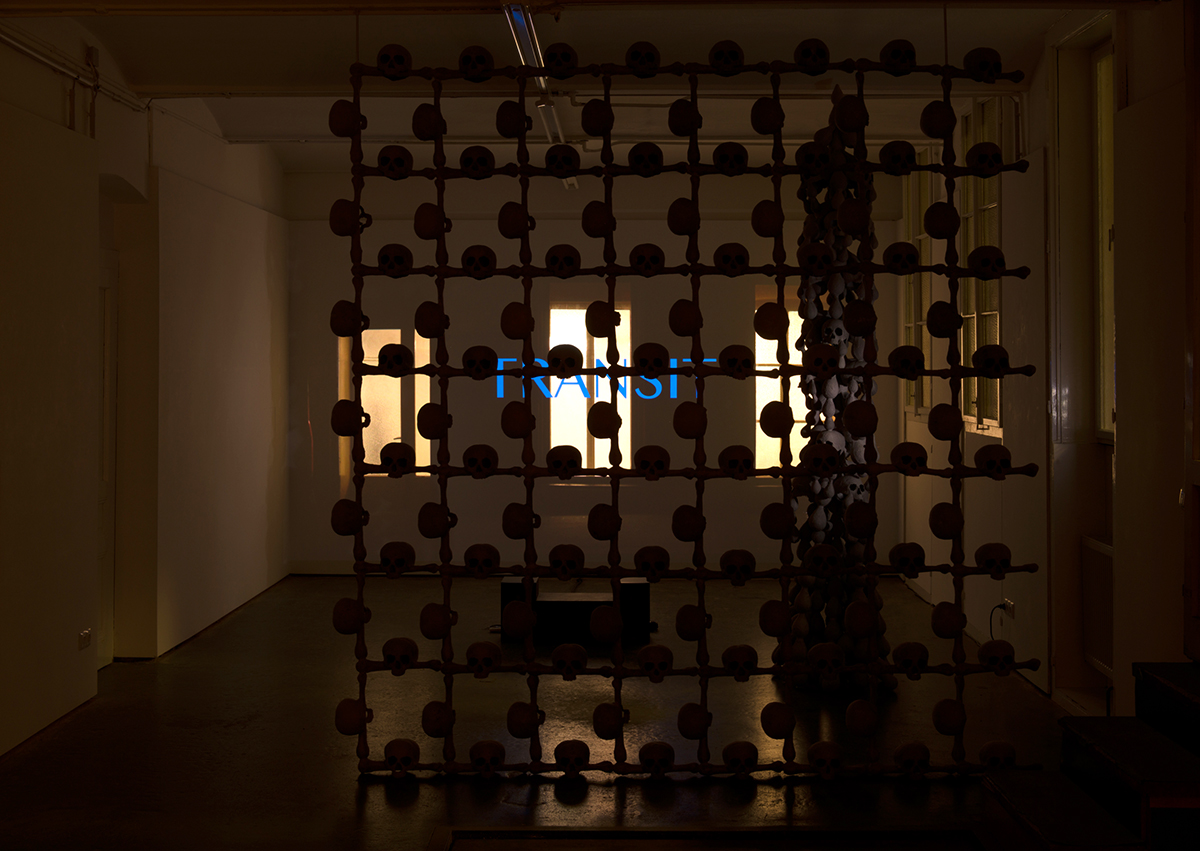
Transit, exhibition view
Video: Stefan Lux
Accordion & Artwork: Ulrike Johannsen
Text: Yuki Higashino
Video projection at the production site,
Clubclub Wien, 2022
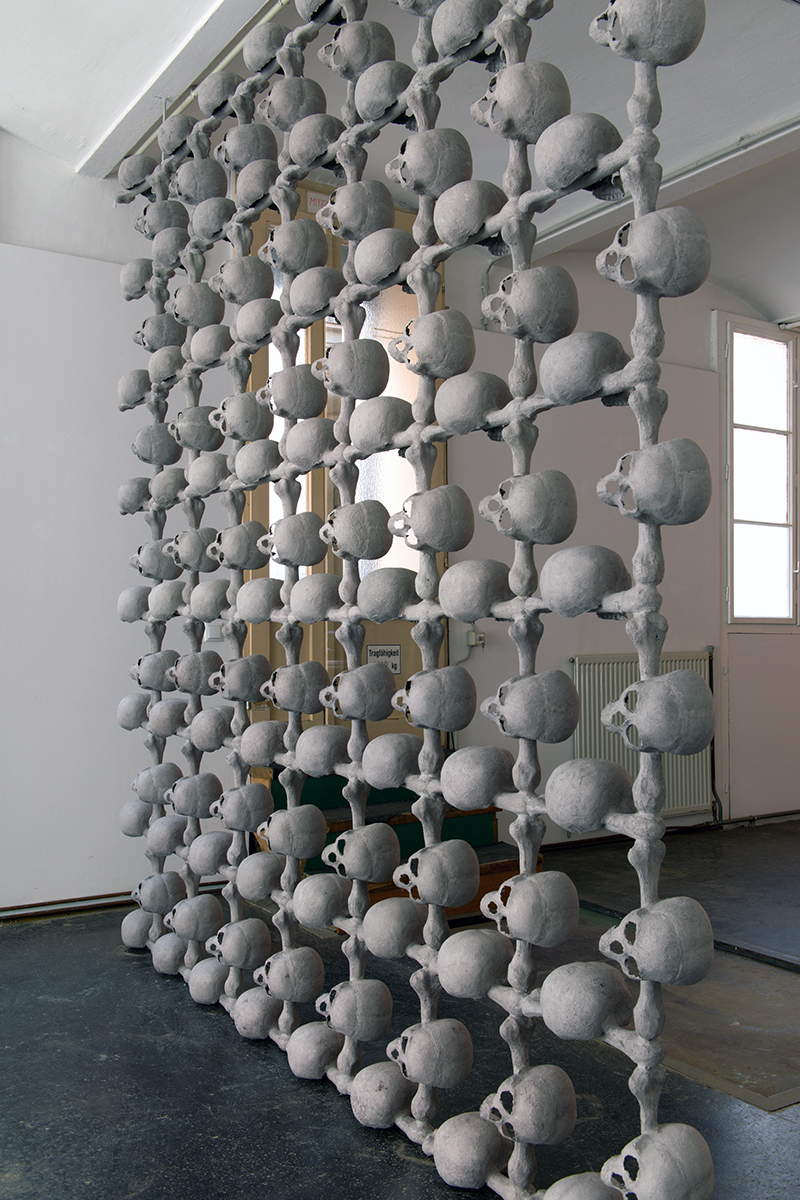
The setting, Ulrike Johannsen, wall, papermachée
300 x 350cm, 2022
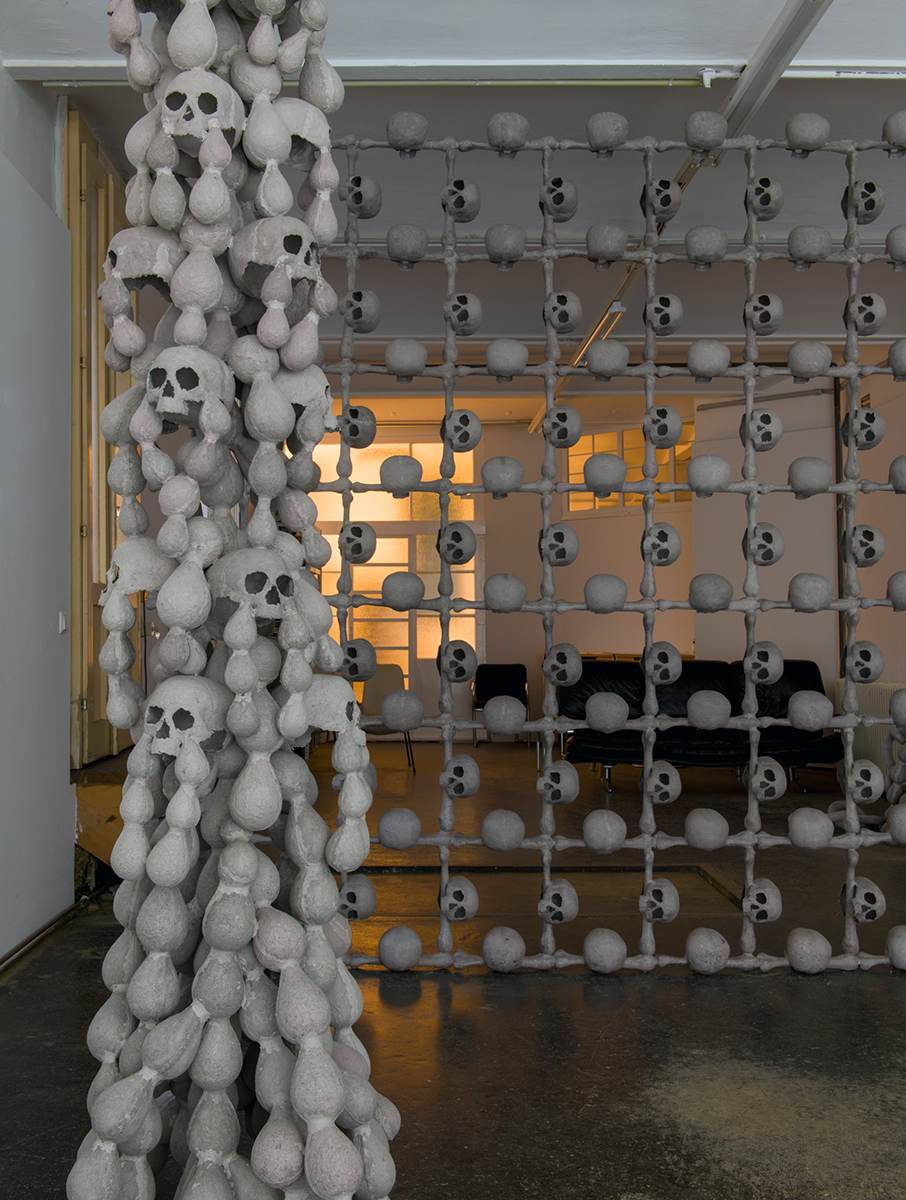
The setting, Ulrike Johannsen, column, papermachée
300 x 70 x 70cm, 2022
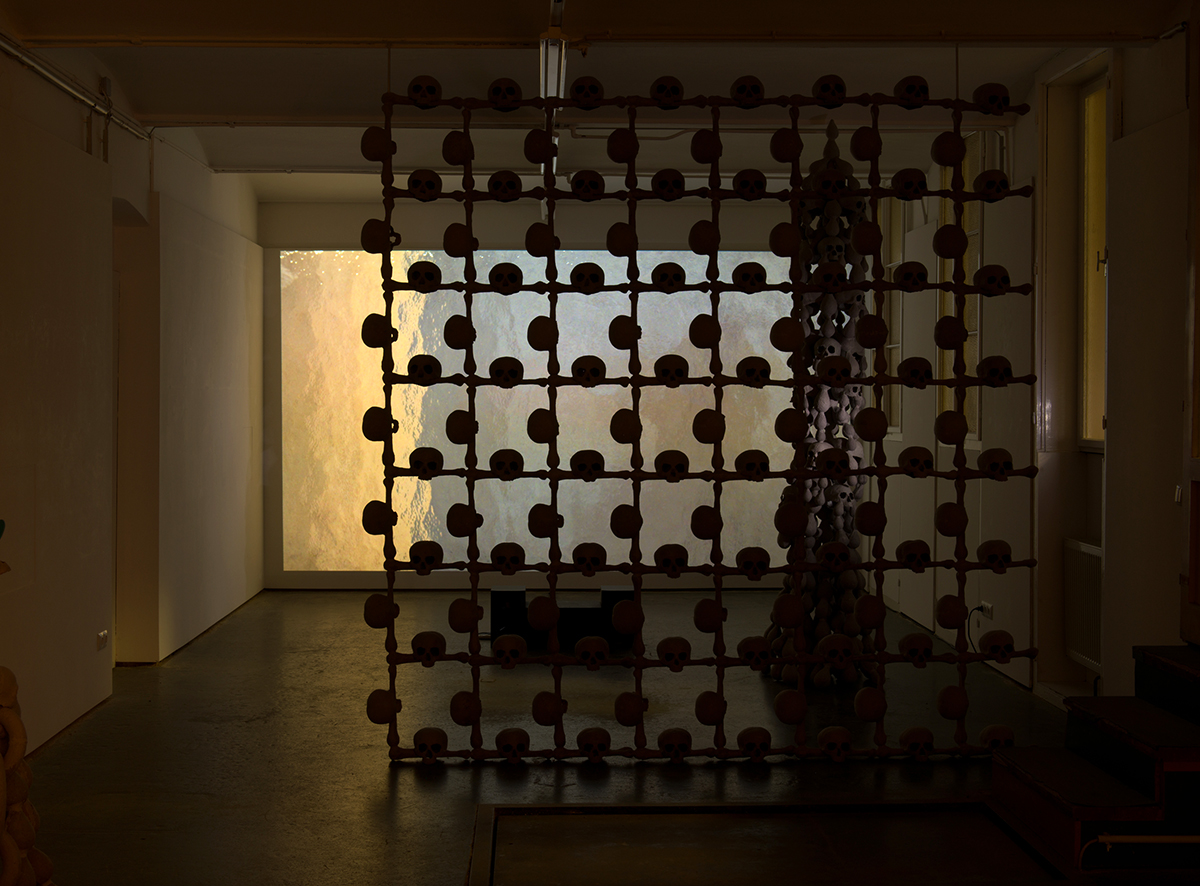
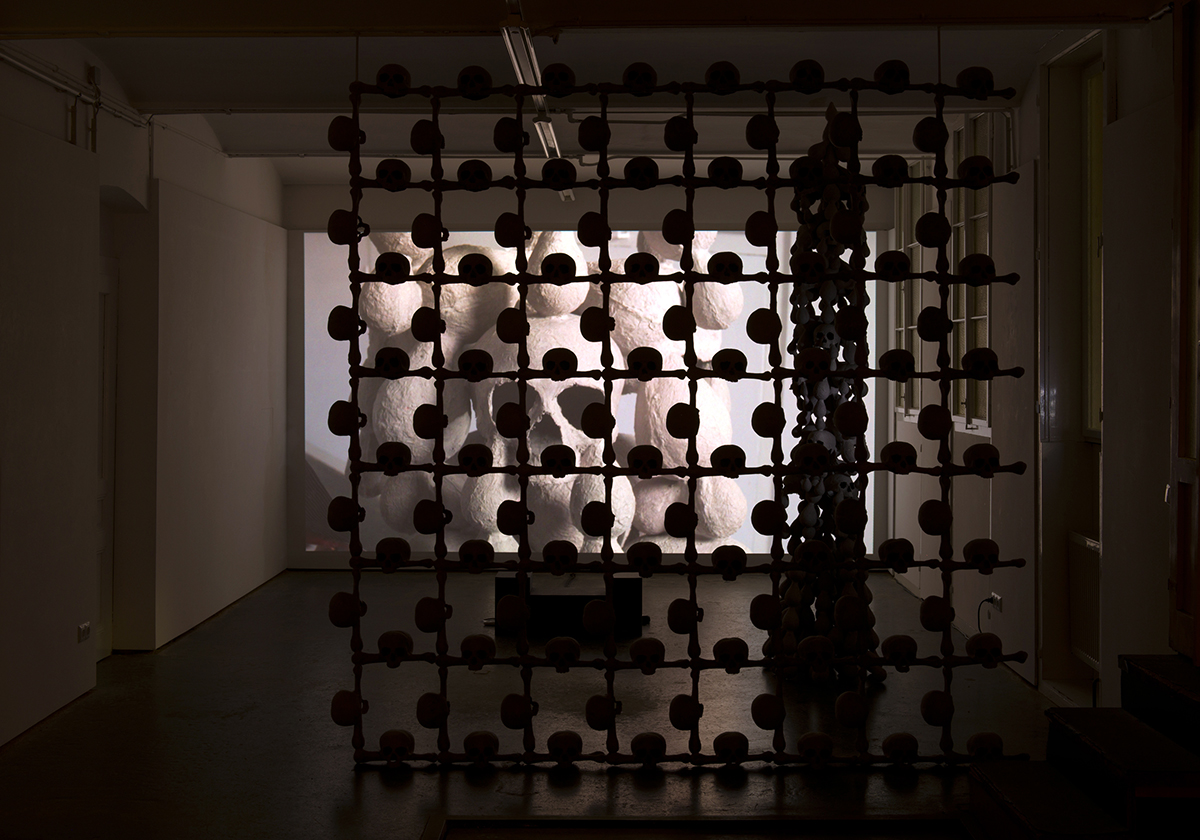
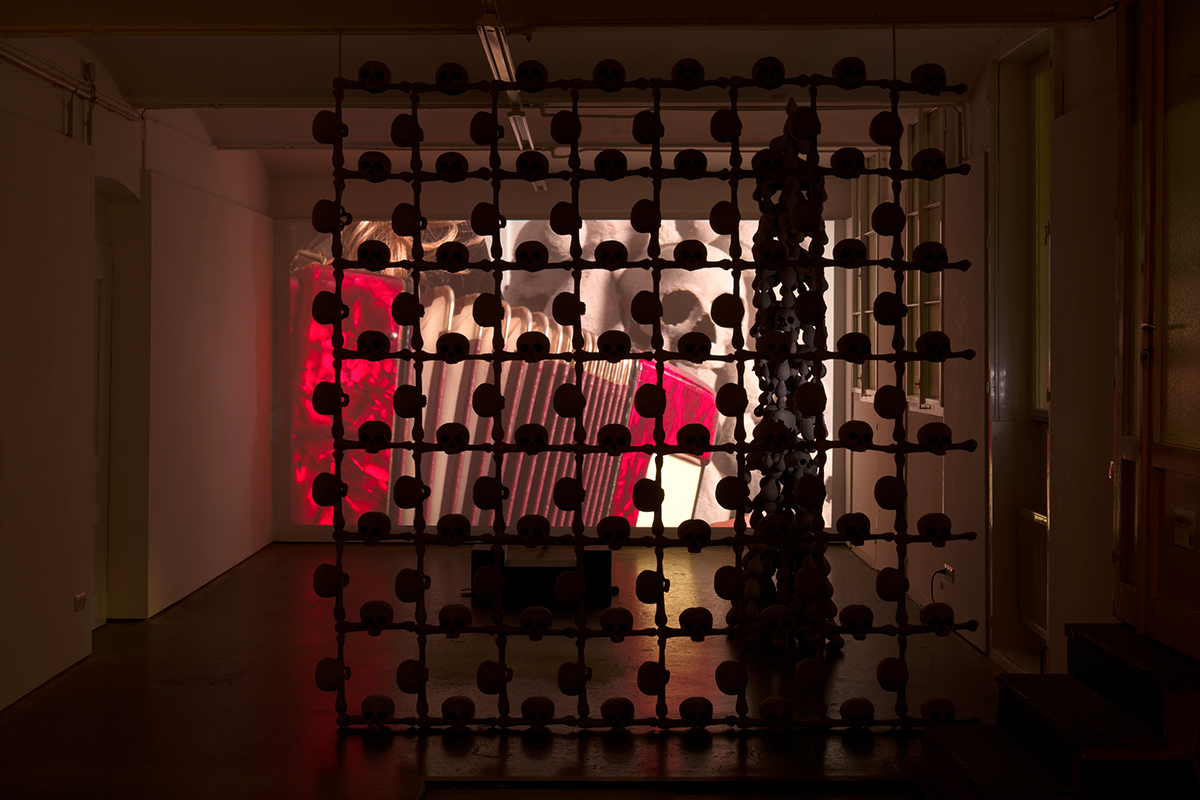
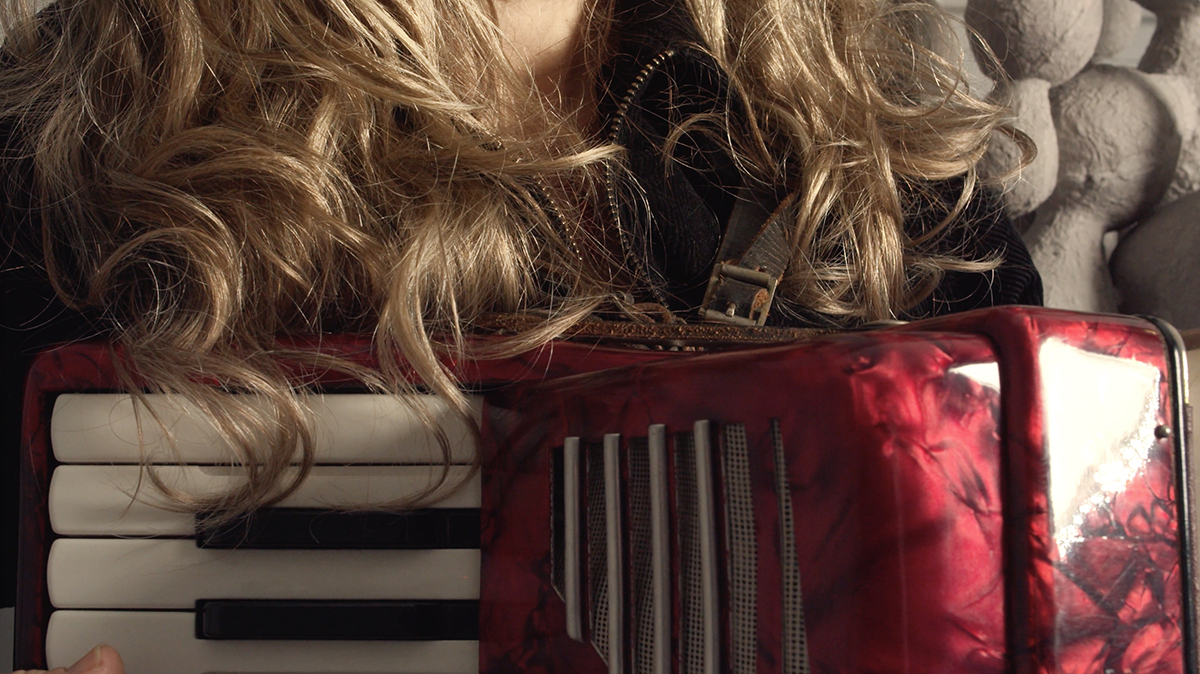
Stefan Lux, Transit, video 4K, 10‘ 40“, 2022

There is a painting of Mary Magdalene by Titian. She is contemplating the sky, her long, wavy hair loose and cascading over her shoulders and chest. In front of her is an open book resting on a skull. This woman, the chief disciple of Jesus and the leader of the early church, according to the Gnostic tradition, is often depicted with a skull. Presumably as a memento mori but after being paired in so many pictures, she developed a strange familiarity with this most macabre of objects. Being the primary witness to the resurrection, death was her friend. There is another painting, this one by Georges de La Tour, where she has a skull on her lap and rests her hand on it as though it was a cat. Tender. The picture has that typical La Tour stillness, and the skull is the most animate presence in it. Its upward gaze mirrors Titian’s Mary Magdalene and with its jawbone missing, it perpetual laughs. It’s a funny skull.
In the video by Stefan Lux, we see long blond hair and skulls. Both the hair and the skulls belong to Ulrike Johannsen. The hair is hers and the skulls her sculptures. She is playing an accordion. She is singing.
She is singing “Wenn ich mir was wünschen dürfte” (“If I Could Wish for Something”) by Friedrich Hollaender, made famous by Marlene Dietrich. It is a song about the futility of fulfilled desires. The vacuity of granted wishes compared to the sweetness of expectation. That thing you wanted was worth it only when you were longing for it.
She is singing. She is in her studio. We are in her studio.
We are in her studio listening to lines like “Ich schaue in die Stuben durch Türn und Fensterglas” (“I'm looking into living rooms through doors and windows”) which is exactly what the camera is doing. The camera is outside looking into the room we are in right now, watching the footage it took. It looks in but cannot see anything because the glass is frosted. It can only capture the warm yellow light, diffused and soft. Enticing. And then it is inside. But it is already looking out through the same frosted glass. Outside is night. It is blue.
Does it already want to leave? Perhaps. This room it so wanted to enter is full of skulls and inhabited by a woman who sings of the pointlessness of fulfilled wishes. She conjures these cousins of La Tour’s droll skull by the dozens. How beastly. But it is night out there. The song fades. In the end, the camera is back on the street, focused on the pale reflection of the warm yellow light of the room it just left on the window of the car parked outside. A Ford Transit.
Hollaender was a Jew, like Mary Magdalene. A successful film and cabaret composer in Berlin, he was forced to emigrate in 1933. He found himself in Hollywood and had an illustrious career there, teaming up again with Dietrich.
He went back to Germany in 1956 though. And settled in Munich of all places. That is mindboggling. Why would anyone, let alone a Jew, do that? The stench of death couldn’t have cleared yet. Skulls strewn across its blood-soaked earth. I can only speculate. The cultured and secular Jews of Europe really, really wanted to assimilate, to be admitted into that enlightened civil society they thought existed across the invisible threshold, as inviting as the yellow glow of a warm room seen from the street in a cold night. But that room was full of death and destruction in reality. That thing they wanted turned out to be night. Europe was attractive to Jews only when they were wishing for it. Could Hollaender not let go? Also, he wasn’t the only one who went back. Were they chasing the pale reflection of that non-existent society into which they wanted to assimilate?
Paul Celan wrote, “A man lives in the house he plays with the serpents he writes / he writes when dusk falls to Germany your golden hair Margarete,” in Death Fugue. He wrote:
Ein Mann wohnt im Haus der spielt mit den Schlangen der schreibt der schreibt wenn es dunkelt nach Deutschland dein goldenes Haar Margarete Dein aschenes Haar Sulamith wir schaufeln ein Grab in den Lüften da liegt man nicht eng
Er ruft stecht tiefer ins Erdreich ihr einen ihr andern singet und spielt
A man lives in the house he plays with the serpents he writes he writes when dusk falls to Germany your golden hair Margarete your ashen hair Shulamith we dig a grave in the breezes there one lies unconfined
He calls out jab deeper into the earth you lot you others sing now and play Music, hair and corpses. It is an enduring image. It so happens that bones and hair are the two things that last the longest when we die. They are the least transitory of our constituents, even though we shed hairs regularly. But bones are our cores, while hairs are the extremities of our body. Is their longevity, well after our passing, a grim form of inside/outside dialectic? Maybe. But we will be too long gone to find out what happens when they meet without any flesh obstacles, even though, technically, they are us.
Yuki Higashino
The loneliness of people in the lockdowns during the pandemic and the associated economic problems have raised the question of social priorities and, as a result, the question of the relevance and tasks of art and culture. In our modern consumer society, the focus is on entertainment value, so that in the public debate art and culture is primarily associated with luxury. One important function has often been overlooked, namely that of art and culture as carriers of personal and social identity. Political theorist Chantal Mouffe argues that every artistic form has a political dimension: “Artistic practices play a role in the constitution and maintenance of a given symbolic order, or in its challenging, and this is why they necessarily have a political dimension”. The ideas transported, brought into a form, represent a political world and position oneself within this world.
Friedrich Holländer‘s song „Wenn ich mir was wünschen dürfte“ transports the attitude towards life of the 1930s in the lyrics and the melody and is transcribed into the present by Johannsen‘s interpretation with accordion and voice. The architecture in which the exhibition took place and the video was shot also dates from the 1930s, as does the surrounding architecture of “Red Vienna” in the 15th district. Architectural utopias were created at this time, commissioned by the social-democratic city government of Vienna. An example is the „Heimhof“, which had a communal kitchen in which employees cooked for the residents in order to make housework easier for working women. The project was functionally dissolved by the National Socialists and the social democratic and Jewish residents evicted. The collaborative work by Stefan Lux and Ulrike Johannsen consists of a video that Stefan Lux shot in the same space where it was later shown and Ulrike Johannsen‘s sculptural setting. The space is thematized as well as the threshold situation between inside and outside, between private and public areas. As a third component, the artist Yuki Higashino wrote a text. However, this is not a description of the installation, but a text in free association, an additive element.