


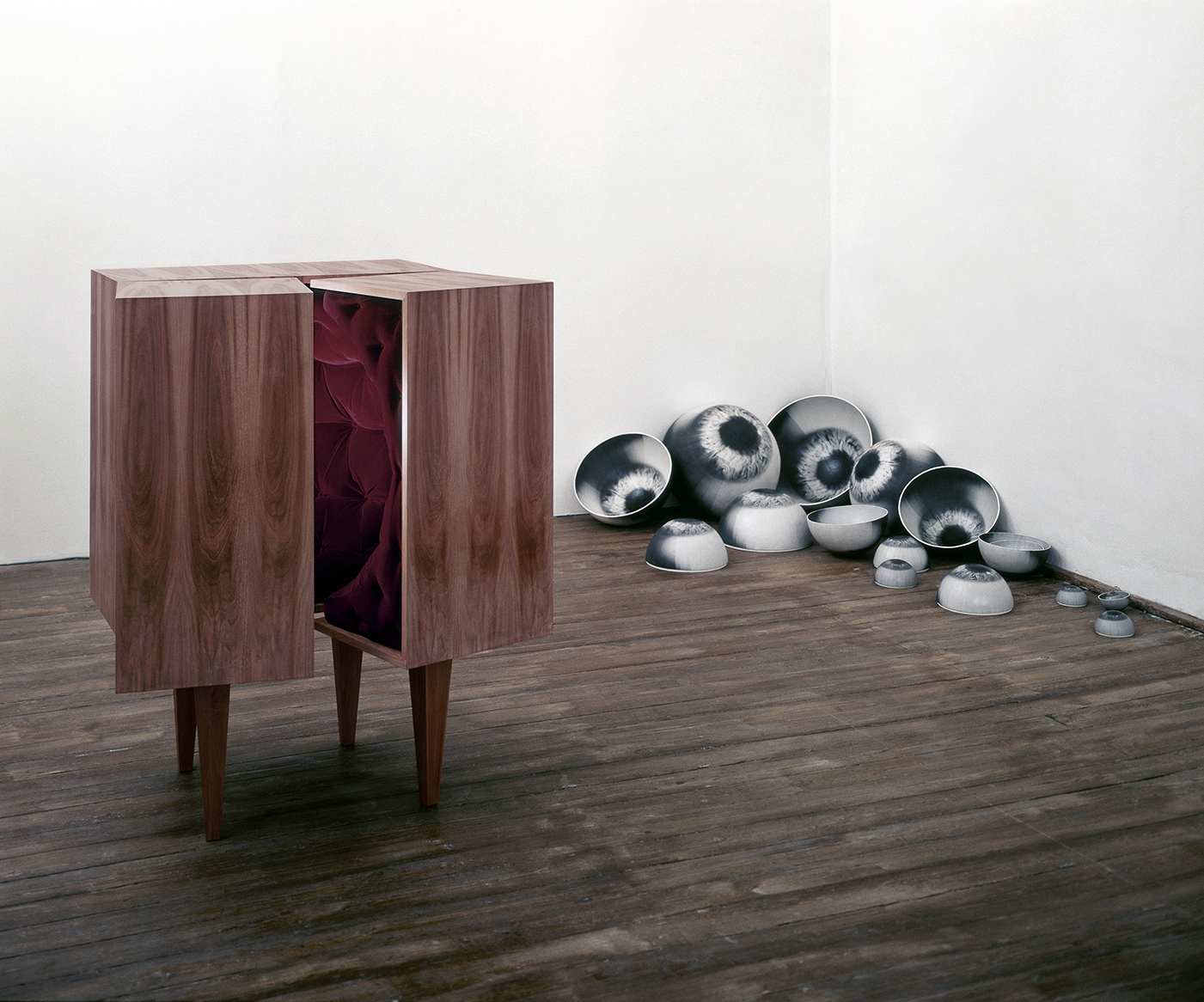
Augenarbeit, upholstered convertible cube, 80 x 80 x 150cm
carton board squeres, eyeball photo measurements variable
OK Linz, A, 1994
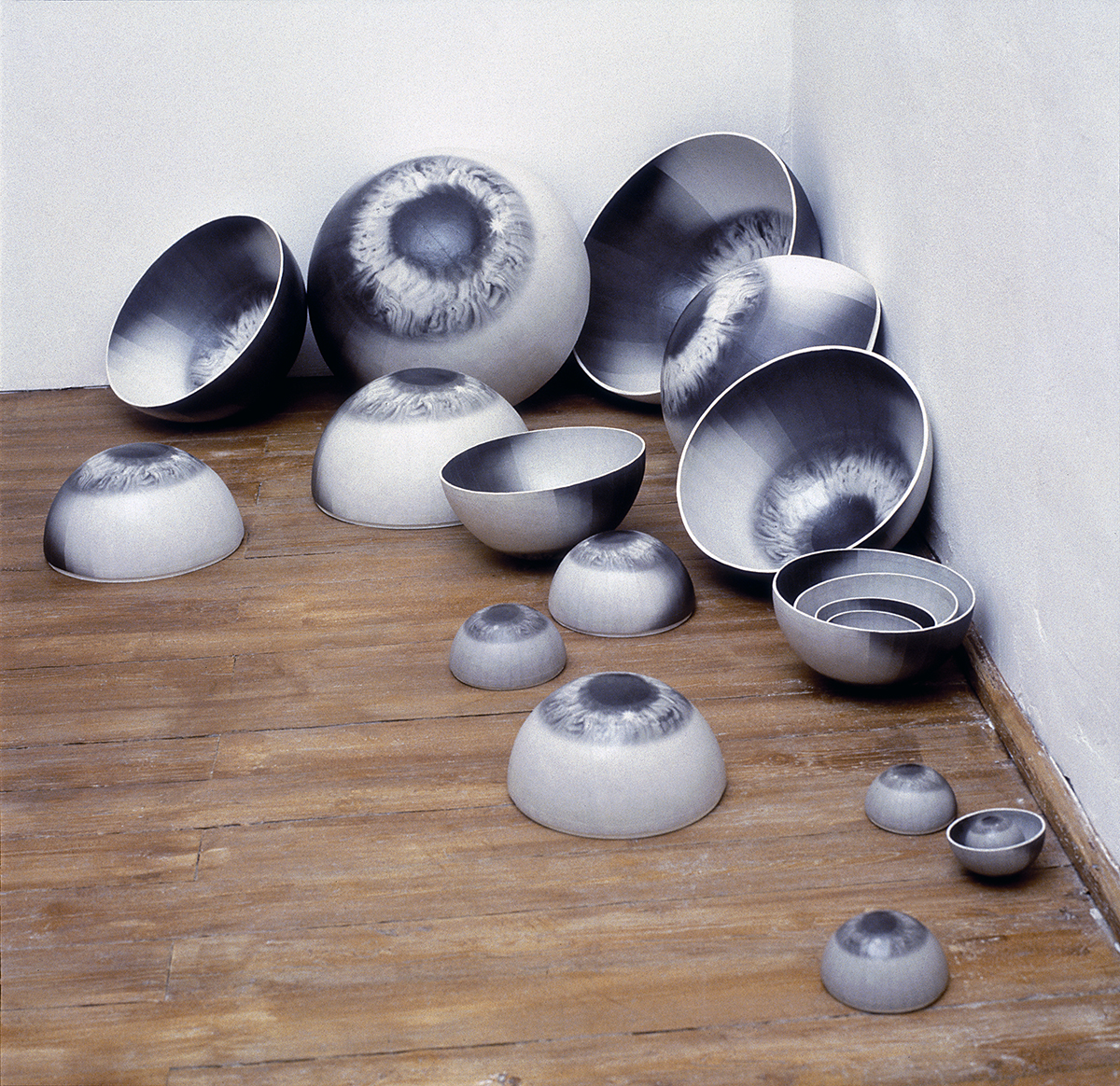
Eyeball spheres, detail
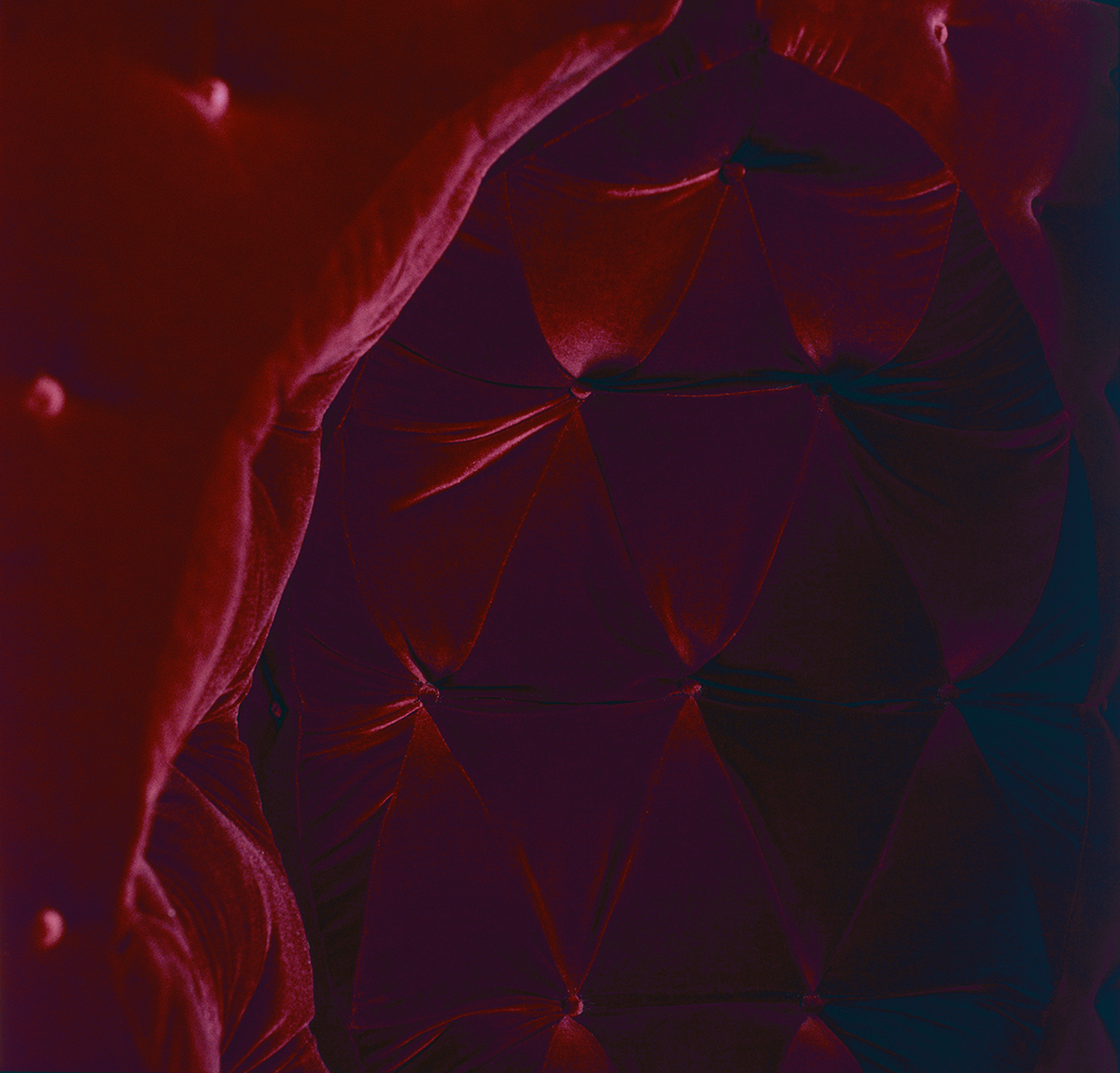
Inside the cube
Visitors to Johannsen’s space are first of all confronted with a “piece of furniture”, an 80 x 80cm wooden cube
on 40cm-high legs. From this perspective, the closed back wall blocks your view, apart from the grain in the
veneer there is nothing to be seen. The object resists interpretation. Its shape is admittedly reminiscent of a
60s TV cupboard, but the object, its use, its function and its contents remain a secret. However, even after the most cursory of glances you can see that the box’s shutter doors are ajar, you discern a slit that goes right through the whole “body”. the prospect of looking into the box from the opposite side draws us into the room, and with this we start to see other parts of the room for the first time, for example the cardboard hemispheres that now come to our attention, lying on the floor in the left corner of the back wall. There are 20 hemispheres, ranging from 6 to 50cm in diameter, with photographs of eyeballs mounted on both the inside and outside.
We see some of the hemispheres from the front, others from the back, some are placed inside one other, and
the smallest, and therefore the closest in terms of volume to the human eye, is closed. Despite the impression that someone got tired of playing with the spheres and simply hasn’t “tidied” them away, we quickly realise the
principle behind them. Like a set of Russian dolls, all the parts fit into each other. If they were “tidily” put together
we would only be able to see the last, biggest sphere, the others would be invisible. The doll inside the doll: here we have the eye in the eye, and that twice over: from the outside and the inside, so the eye in the eye in the eye in the eye… once we have seen the eyes, they follow us around the room, as we walk around the – incidentally reversible – box in order to see what it might hold for or hide from us. Johannsen’s object, hard
and unwieldy from the outside, surprises the visitor with a dark-red, velvet cushioned lining inside. The padding
is thick and meaty, its buttons are pushed deep into the velvet, and the luxurious folds they form could them-
selves be hiding places. Padding made from expensive material is used in our culture and other cultures alike
to protect precious things, to transport them or present them in an appropriate fashion. We begin to wonder more and more about the missing precious object. It doesn’t take us long to find it: the cushioning shows a round
imprint which has roughly the same diameter as the biggest eyeball, 50cm. So the balls, stacked inside each
other, fit into the box. This turns out to be the container for the eyes, they can be safely stored in here. An object that so calculatedly provokes our desire to see and then teaches us a lesson about this desire - it makes us aware of the way our will to see and penetrate things is structured: it is the search for a treasure that is always already missing. Ulrike Johannsen’s installation gives us a lot to see: eye-work.
Sigrid Schade